More independence starts with more control.
FreeWheel is a team project for more inclusive cycling: a modular retrofit braking concept supported by a route to adoption, manufacture and service. My contribution focused on customer segments, market sizing and customer relationships.
Explore the process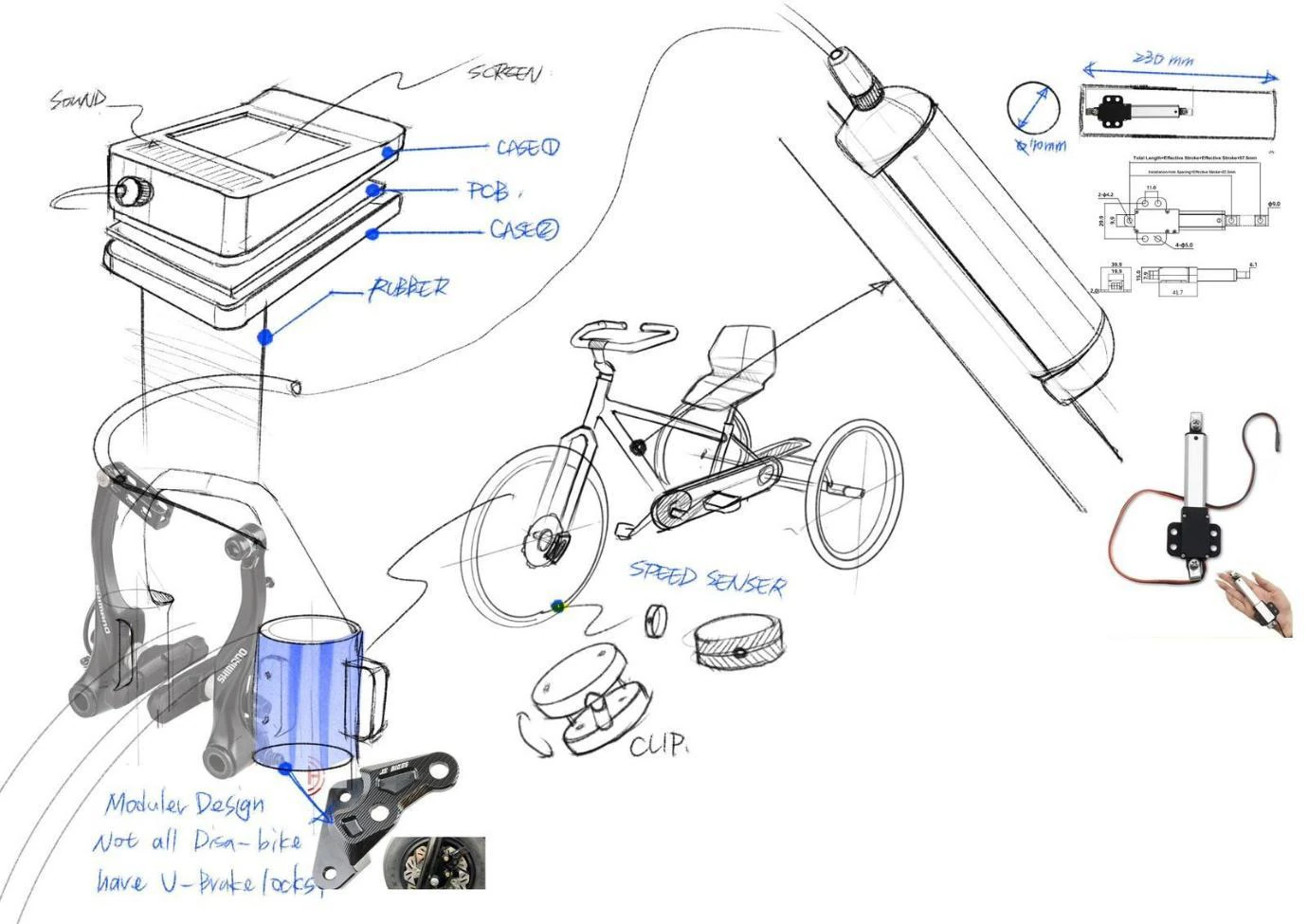
Team member · customer segmentation, market sizing and customer relationships
Inclusive design · stakeholder mapping · commercial modelling · product systems
Adapt the bicycle to the rider.
A standard brake assumes the rider has enough grip strength and can recognise when and how hard to stop. Riders who need lower-force input or additional support may require a different interface, while community cycling organisations need equipment that can serve many people.
The team proposed a modular retrofit kit that builds on an existing bicycle: adapt the fleet already in use, replace individual components and support different controls.
Riders
Support a wider range of physical and cognitive needs.
Clubs
Adapt shared fleets for different people and sessions.
Support network
Consider volunteers, families and professionals around the rider.
Three layers of support.
The report defines a mechanical baseline, an adaptive interface and a proposed anticipatory intervention. Existing braking remains the foundation; alternative controls and sensing form the next layer. The final layer proposes warnings and assisted slowing when set thresholds are exceeded.
These are concept behaviours and product requirements. The work presents the architecture and commercial proposal, rather than certified brake performance or validated automatic intervention.
01 / Mechanical
Retain a conventional braking baseline.
02 / Adaptive
Offer low-force controls suited to different riders.
03 / Anticipatory
Propose alerts and assistance based on speed and context.
Make the route to adoption as clear as the product.
I focused on identifying who would use, buy, recommend and support FreeWheel. Those are different relationships: a club may purchase a kit, a rider experiences it, an occupational therapist may influence adoption, and a funder may enable access.
The customer strategy prioritised cycling organisations, with a route to individual riders and families. My presentation responsibilities covered those customer segments, market sizing and how relationships would be developed and retained.
Primary customers
Inclusive cycling clubs and community organisations.
Individual customers
Riders and families seeking adapted equipment.
Professional influences
Clinicians and occupational therapists.
Enabling partners
Local authorities, funders and community networks.
A design needs a way to reach people.
The wider team report linked the concept to standard components, locally sourced electronics, printed housings, subcontracted brackets and small-batch assembly. The sequence included sourcing, customising, assembly, verification and delivery.
The commercial work examined component costs, capacity, distribution and replacement parts. These were planning assumptions, rather than achieved sales or production results. The central principle was to keep the product modular enough to maintain and adapt over time.
Source
Use standard, replaceable components where possible.
Assemble + verify
Bring modules together with a defined checking process.
Support
Build service and customer relationships into the offer.
Gold Award in Inclusive Sports Design.
FreeWheel received a team Gold Award in Inclusive Sports Design 2025–26, Brief D. The recognition reflects the combined work of the team across inclusive product thinking and a practical commercial proposal.
For me, the project showed how understanding customers and their support network can sharpen a product’s direction, especially when the person using it is not the person buying it.
Inclusion is a product-system problem.
The project brings together the physical device, the people around the rider and the practical route to adoption.
What the project delivered
- Team retrofit braking architecture
- Customer and stakeholder segmentation
- Commercial and manufacturing proposal
- Team Gold Award recognition
Where I would take it next
- Validate braking and interface performance
- Trial with intended riders and cycling organisations
- Refine procurement, service and production assumptions
FreeWheel team report, pages 3–16 and 19–25; CW2 storyboard, Om’s assigned contribution on page 6; updated portfolio, pages 16–17.
Gaming kit, ready to travel.