Read the pitch. Support the curator.
The 22-Yard Analyst explores a portable sensing system for cricket-ground conditions. It connects my cricket background with product-system thinking: what should be measured, when intelligence is useful, and how the curator stays in control.
Explore the process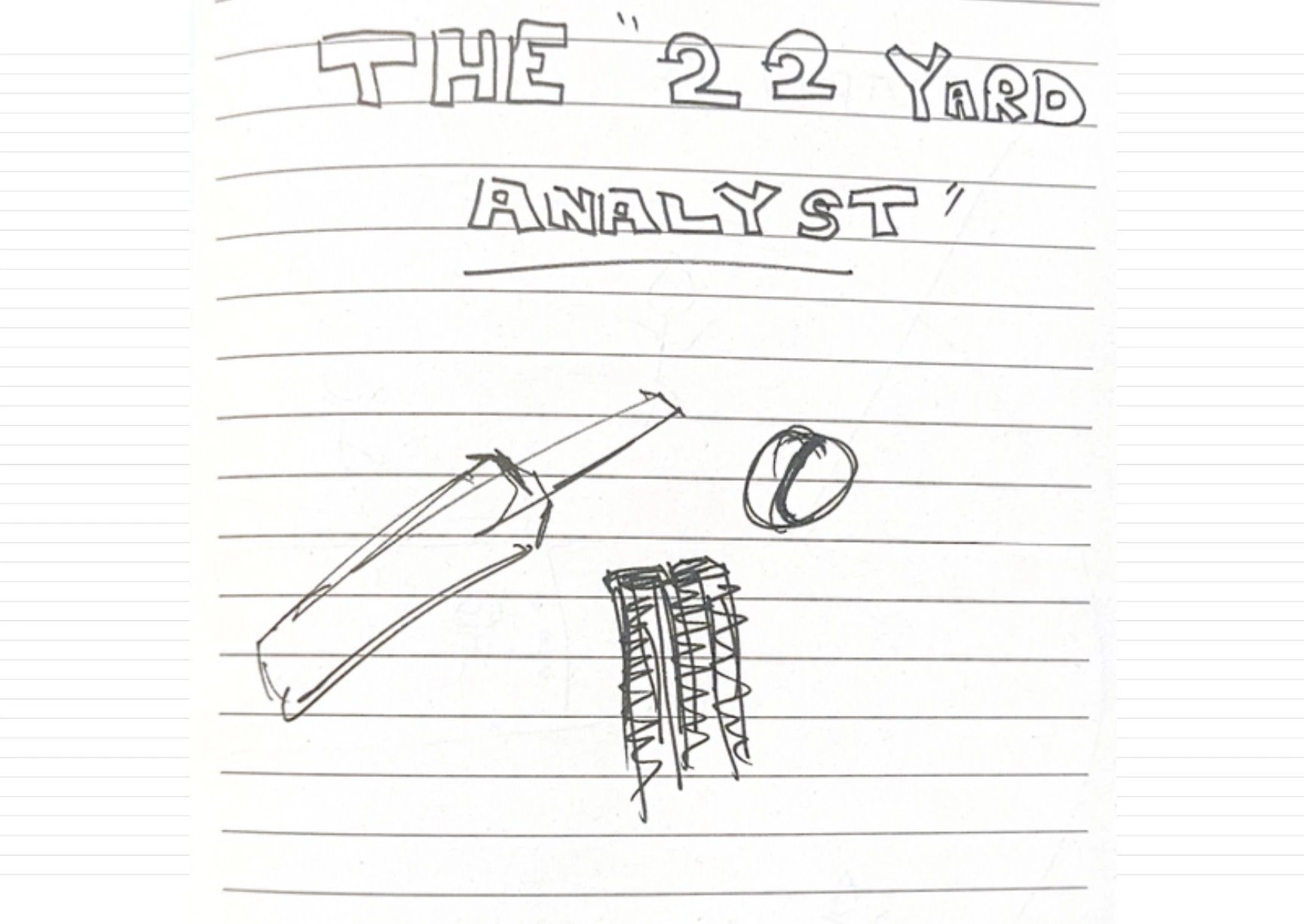
Opportunity framing, sensing architecture, workflow and responsible-AI exploration
Concept notebook · multispectral sensing · IMU · TinyML architecture
Turn inspection into a more consistent record.
Pitch and outfield preparation depend on experienced judgement, visual inspection and physical measurements. The concept asks whether a portable device could help record conditions more consistently before a match.
The proposed workflow is to scan the surface, review a condition map and use that information to support watering or rolling decisions. The curator remains responsible for interpreting the result and deciding what to do.
Two signals. One grounded question.
The proposed hardware combines an AS7265x multispectral sensor with a nine-axis inertial measurement unit, using an Arduino Nano 33 BLE Sense as the edge-computing platform. Spectral information would inform turf condition; vibration or impact signatures would be investigated against surface hardness.
TinyML is a proposed route to local inference on a battery-powered device. It is useful only if the sensors, training data and workflow support a better decision than a simpler rule-based method.
Collect
Record spectral and inertial signals under known conditions.
Reference
Pair signals with trusted ground measurements and context.
Infer
Explore compact models that can run locally.
Review
Present evidence and uncertainty for the curator to interpret.
A reading is not yet a reliable prediction.
The study identified the need for collection, storage and trusted reference data before model development. A pitch-behaviour model would need examples across soils, turf types, moisture conditions and grounds.
The report discusses moisture and hardness benchmarks as intended evaluation references. No trained-model accuracy, calibrated sensor performance or validated prediction of match behaviour is claimed.
Ground truth
Compare measurements with established reference methods.
Dataset coverage
Represent different surfaces and conditions.
Evaluation
Test on grounds outside the training set.
The housing is part of the data system.
Two risks shaped the concept. A model trained in one region may fail on another type of pitch. Changing sunlight may also change the multispectral reading before the surface itself has changed.
Proposed responses include more diverse training data, explicit regional context and a skirt or enclosure to control illumination. An industrial-design decision directly affects the quality of the data.
Different ground
Avoid assuming a model transfers between unlike surfaces.
Different light
Make scanning conditions more repeatable through the enclosure.
Different decision
Keep the result advisory and show its limitations.
First ask whether AI is necessary.
The project changed my framing from “what can AI add?” to “what evidence would make this useful?” A clear measurement workflow and an understandable output matter more than a complex model.
A future prototype should first prove repeatable sensing and a useful relationship to ground condition. Only then would it be reasonable to compare simple rules with machine-learning approaches.
A concept with a testable next step.
The output is a sensing and decision-support architecture, supported by a critical view of its data requirements.
What the project delivered
- Pitch-inspection workflow concept
- Multispectral and inertial sensing architecture
- Local-inference and human-review strategy
- Identified generalisation and lighting risks
Where I would take it next
- Build and calibrate a sensing prototype
- Collect paired sensor and reference data
- Compare simple rules with trained models
- Evaluate usefulness with ground curators
22-Yard Analyst presentation, pages 1–9; AI product-development notebook, pages 21–31; updated portfolio, page 18.
Look closer. Question the assumption.