Listen to the words. Watch the routine.
An exploratory study of pet owners in Loughborough examined how people understand air quality in everyday life. Interviews and observation revealed a gap between stated concerns and the small protective actions embedded in daily routines.
Explore the process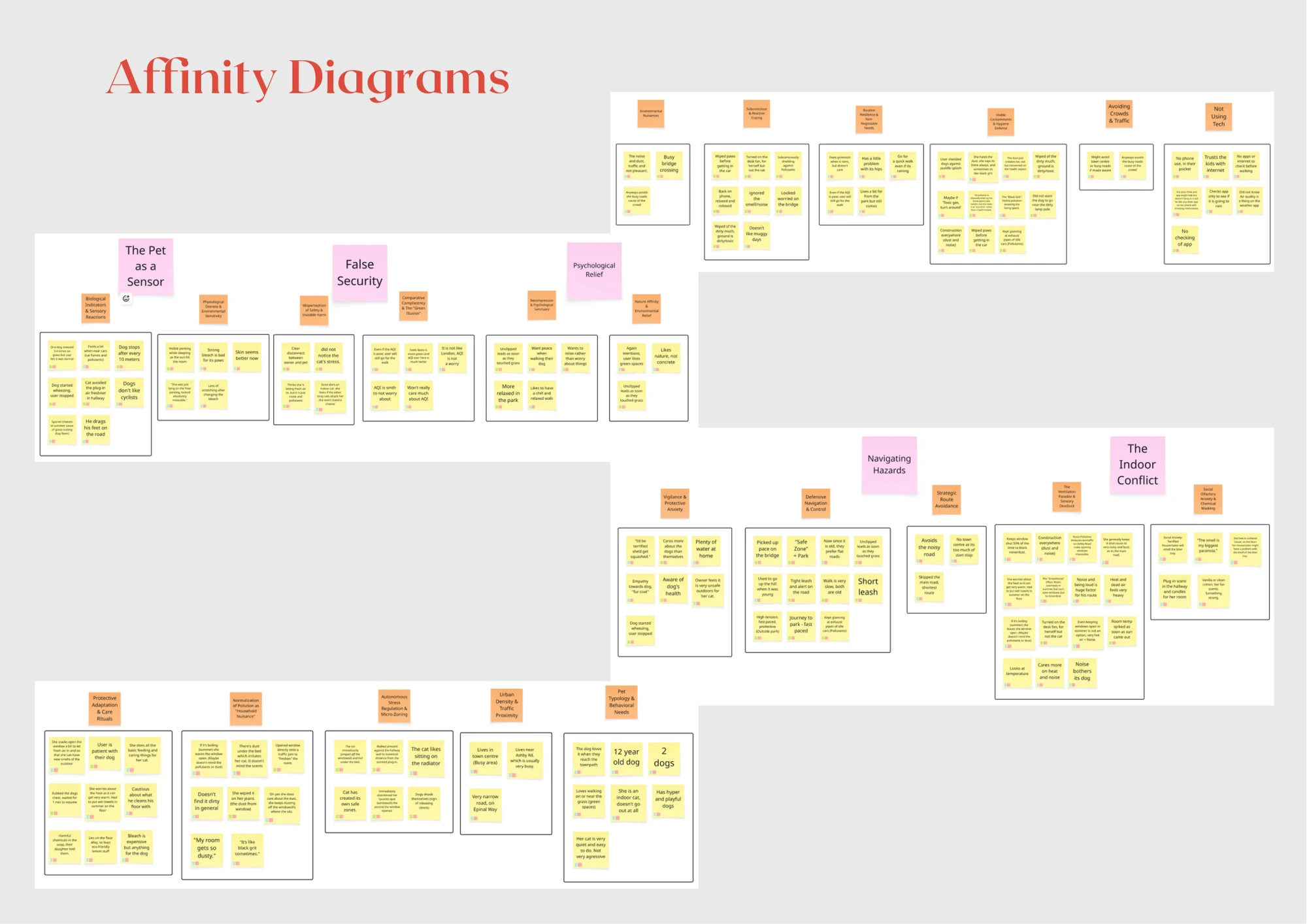
Observation, interviews, evidence coding, affinity mapping and synthesis
Fieldwork · triangulation · affinity diagrams · opportunity statements
How does an invisible issue show up in behaviour?
The study explored pet owners’ experience of air quality across homes and walking routes. Rather than begin with an app or a product, I used interviews to understand beliefs and observation to document what people actually did.
The small sample supported exploratory insights, not population-wide conclusions. Behavioural observations were evidence for design questions, not medical diagnoses or proof of pollution exposure.
Interview
Ask how participants describe their concerns and choices.
Observe
Watch ordinary routines, workarounds and changes in behaviour.
Compare
Look for agreement, contradiction and missing context.
The contradiction was the useful part.
One participant described the local area as green and air quality as a low concern. During the walk, however, shortened leads, a faster pace and protective positioning appeared along the road; posture relaxed on entering the park.
Another described opening a window for fresh air, while observation showed a competing need to shut out traffic noise. People were balancing several immediate pressures; more information alone might not resolve them.
Said
Air-quality data was not part of the usual routine.
Observed
Protective actions and changes of pace already existed.
Interpreted
Support familiar decisions instead of assuming an information deficit.
Organise by behaviour, not by participant.
I broke down the source material into observations and statements, then clustered notes by recurring behaviour. Moving away from one group per participant made connections visible across different routines.
Noise avoidance, a closed window and an overheated room came together as a ventilation tension. Reactions to a pet’s visible discomfort clustered separately from the use, or absence, of digital information.
Three tensions worth designing around.
The synthesis produced several directions to investigate. Each is an interpretation of this study’s evidence and a starting point for further research.
The journey matters
The route to green space created different behaviours from the green space itself.
Signals need relevance
Participants reacted to immediate cues more readily than abstract numbers.
Competing comforts
Noise, heat, odour and shared-house expectations shaped indoor decisions.
A better brief starts with a better question.
I developed “How might we” statements from the insights and prioritised five directions against innovation and impact. They explored clearer environmental cues, route-level support and better indoor micro-environments.
The next step would be to return to participants with simple propositions and test whether those ideas address a real need. Any health-related indication would require separate scientific validation.
Routes
How might we support the difficult parts of the journey?
Signals
How might we make environmental information easier to act on?
Homes
How might we improve ventilation while addressing noise and comfort?
From assumptions to a more useful brief.
The main result was a shift from assuming people need more data to understanding the routines and competing needs that shape their choices.
What the project delivered
- Interview and observation evidence
- Traceable affinity mapping
- Cross-method comparison and interpreted themes
- Five prioritised opportunity statements
Where I would take it next
- Explore the themes with a broader sample
- Validate interpretations with participants
- Prototype and compare opportunity directions
Design Research submissions A (reflection), B (affinity maps, findings and opportunities) and C (interview and observation records); updated portfolio, page 18.
Keep the heat. Reduce the demand.