Keep the heat. Change the routine.
Eco-Nest explores an insulated companion vessel for rice cooking. Lifecycle assessment and thermal modelling investigate a shift from prolonged electrical heating to passive heat retention, supported by a simple mechanical interface.
Explore the process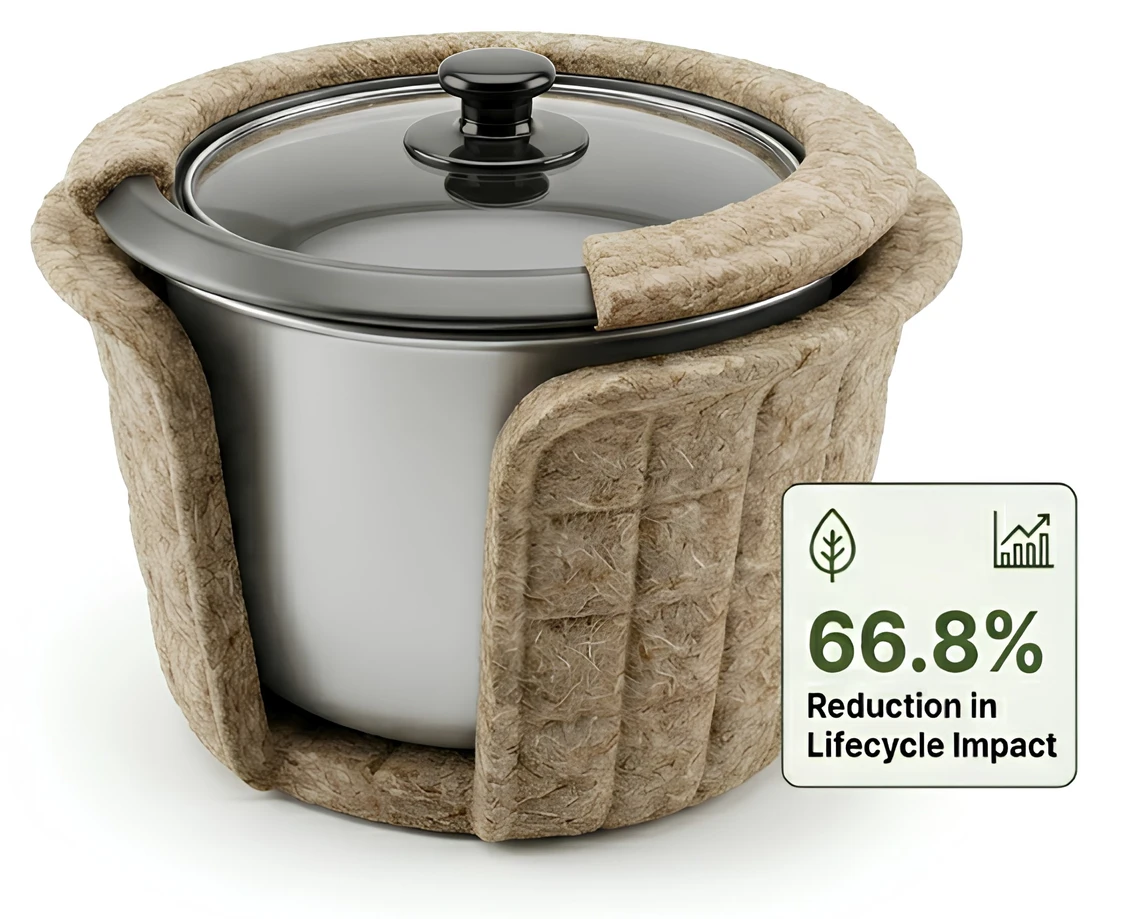
Lifecycle framing, material strategy, product architecture and thermal-model exploration
LCA · thermal FEA · CAD · behavioural storyboarding · material research
The biggest problem happened during use.
The project established a rice-cooker baseline using an Eco-Indicator 99 shortcut assessment. The functional unit was cooking and warming 1.5 litres of rice, 5.5 times per week over a three-year life. Electrical use dominated the model.
That finding changed the direction. A material swap alone would leave the main source of impact in place. I investigated reducing the active heating and keep-warm phases through an insulated companion vessel.
Baseline
Examine the complete cooking and warming routine.
Hotspot
Target repeated electrical use, not only the product shell.
Intervention
Retain useful heat in a passive vessel.
A new cooking cycle needs a clear signal.
The proposed sequence is to prepare, heat briefly, transfer the hot pot into the fitted nest and monitor progress without repeatedly opening the lid. The brief set a five-minute active-heating target, followed by passive retention.
This changes the routine and introduces a hot-pot transfer. The concept considers handles, visible measurement lines and a colour-coded mechanical dial. Safe handling and cooking performance would need physical testing.
Make the insulation a replaceable layer.
The proposed core blends 70% unspun sheep’s wool with 30% hemp fibre. The model uses a thermal conductivity of 0.0365 W/(m·K) and a 30 mm insulation boundary. These are design inputs, not measured properties of a manufactured Eco-Nest.
The architecture separates the pot, a removable silicone interface and the insulating body. Moisture resistance, cleaning and repeated heat exposure remain material-development questions.
Use the model to test the direction.
The transient thermal study explored temperature decay through the structure, allowing comparison with the retention target before manufacturing a test article.
The lifecycle scenario reported a net impact change from 3,864.70 to 1,280.49 millipoints, a modelled reduction of 66.8%. The use-electricity component fell from 3,830.31 to 1,205.49 millipoints in that scenario. Results depend on the assumed cooking cycle and material inputs.
3,864.70 mpt
Baseline total in the lifecycle comparison.
1,280.49 mpt
Proposed scenario total using passive retention.
66.8%
Calculated reduction requiring physical and behavioural validation.
An energy saving matters only if the system works.
Performance depends on more than insulation. The pot must be handled safely, the lid must seal reliably, users must follow a workable routine, and the food must reach and retain appropriate conditions.
The logbook identifies material fatigue, moisture behaviour and the possibility of users adding heat back into the routine. A physical prototype should test these questions together, then feed measured results back into the lifecycle model.
A use-phase problem, reframed through design.
Eco-Nest shows how lifecycle evidence can redirect a brief toward architecture and behaviour, while keeping modelling distinct from validation.
What the project delivered
- Lifecycle baseline and comparison scenario
- Passive vessel and mechanical-feedback concept
- Wool/hemp material strategy
- Digital thermal exploration and risk analysis
Where I would take it next
- Build and instrument a physical thermal prototype
- Validate cooking and safe handling
- Test moisture and repeated thermal cycles
- Update the LCA with measured performance
Eco-Nest 29-page design proposal logbook, pages 3–7 and 12–29; updated portfolio, page 18.
A new way to stay in the forest.