Designed around the person on the flight line.
T-REX explores a hands-free AR helmet for military aircraft engineers. Research, sketching and a physical fit model helped turn an ambitious feature list into clearer requirements for ventilation, stability, protection and controls.
Explore the process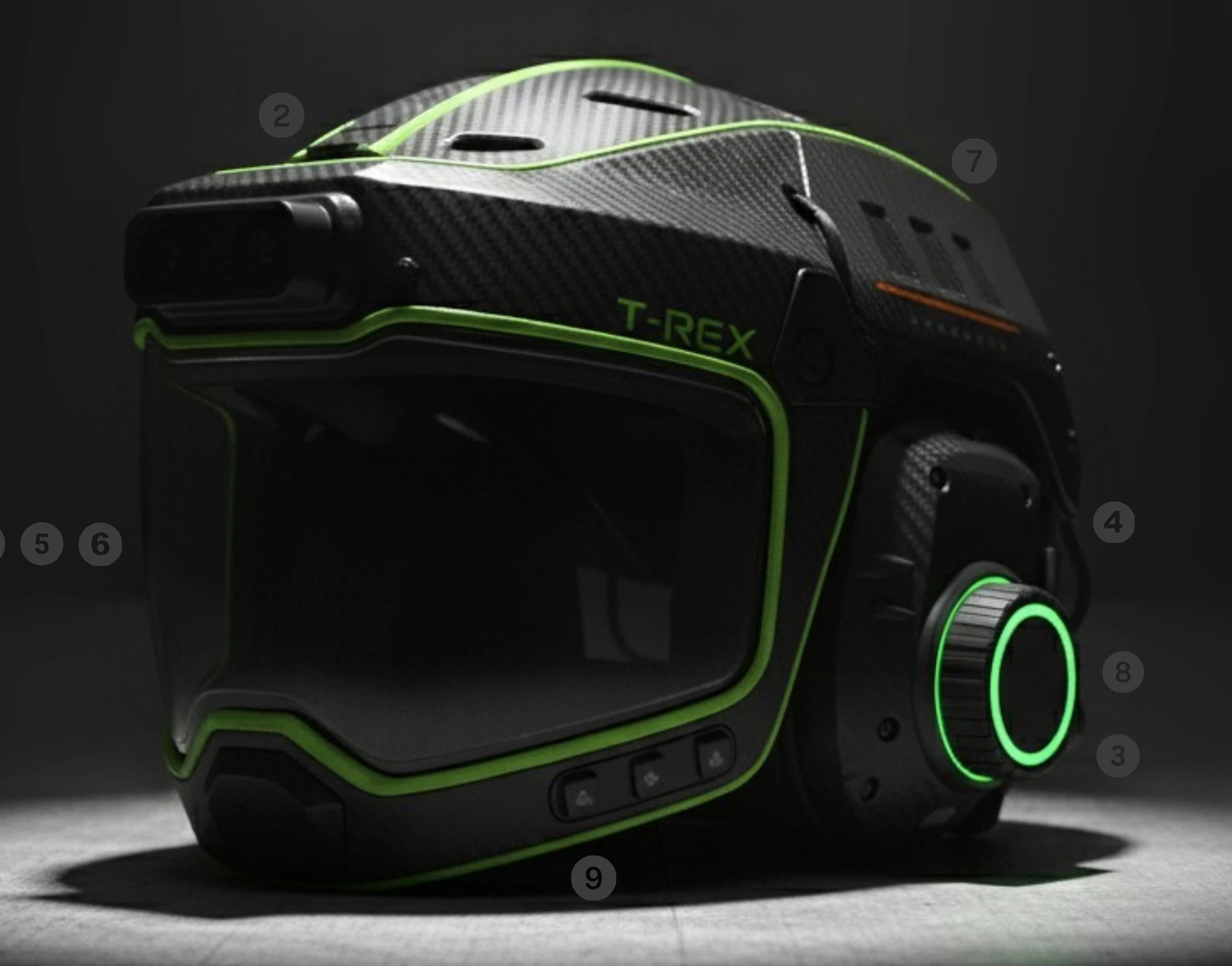
Context research, concept development, physical modelling and refined CAD
Sketch development · form models · ergonomic evaluation · CAD
Complex work needs less distraction.
Aircraft maintenance combines physical access, detailed information and demanding environmental conditions. I explored a wearable architecture that could bring diagnostic information into view while considering noise, airflow and protection.
The research moved from broad military roles toward jet engineers. The design question became how information and protective equipment could work together without adding another object to hold or another control to search for.
Information
Proposed schematic overlays and hands-free diagnostics.
Environment
Consider airflow, noise and conditions around aircraft.
Interaction
Keep adjustment and frequently used controls accessible.
Sketch the relationships, not just the shell.
The sketch studies explored how a visor, ear protection, sensing and ventilation could occupy the same wearable form. The different arrangements helped compare coverage, proportion and interaction.
Robust curving forms and material separation became part of the visual language. But form studies alone could not resolve whether the object would sit securely or leave enough working clearance.
The first prototype challenged the concept.
The physical model revealed poor ventilation, incorrect ergonomic assumptions, an unreliable adjustment mechanism and insufficient stability and clearance. These were fundamental architectural problems.
I returned to the brief. The revised direction called for a tighter, more secure fit, a full-face protection concept and simpler controls: side scroll wheels for adjustment and buttons accessible from below.
Ventilation
Reconsider the openness and airflow of the architecture.
Fit + stability
Secure the helmet before layering in advanced functions.
Controls
Simplify adjustment and button positions.
Translate failures into design decisions.
The next CAD direction brought together an open rear airflow approach, a larger rotary side control, front sensing and a filtered full-face protection concept. The annotations record where those decisions came from.
The final visualisations communicate the intended system. The revised architecture was not physically prototyped within the project timeframe; AR, filtration, thermal vision, noise cancellation and protection performance remain proposed functions.
A more grounded second brief.
The value of the project is the transition from an ambitious wearable concept to requirements informed by physical ergonomic failures.
What the project delivered
- Context research and extensive sketch development
- Physical fit and adjustment model
- Documented ergonomic issues
- A revised, coherent CAD concept
Where I would take it next
- Build and fit-test the revised architecture
- Evaluate weight, ventilation and prolonged comfort
- Validate controls with intended users
- Test proposed protective and electronic functions
T-REX research folio, 20 pages; design and prototyping submission, 5 pages; updated portfolio, pages 13–15.
More confidence. More freedom.